The designer as experimentalist
In 2016, we published a post that opened with a line we'd been saying for years: "Designers are generalists."
It felt true at the time, and it still does.
On any given day, we might be designing a patient screening experience in the morning and a brand identity for a non-profit in the afternoon. We constantly move between industries, perspectives, systems, cultures and people because the work demands it, and because that's where the best ideas come from.
But a decade later, the ground has moved, dramatically. AI can generate layouts, draft code, accelerate production and produce a passable wireframe in the time it takes to write a brief for one. The technical work that used to define a designer's value is, increasingly, no longer the work.
So what is the designer then?
They’ve gone from Generalist to Experimentalist.
The Experimentalist isn't a replacement for the Generalist. It's what the Generalist becomes when the tools get faster than the questions. Where the Generalist had a broad toolkit, the Experimentalist has a broad mindset. They don't apply known solutions. They form hypotheses. They treat design as a tool for inquiry, not just delivery.
For our clients like health systems, hospitals, and the organizations doing complex, important work, this shift matters more than it might appear.
The Experimentalist is curious. They treat every project as a chance to learn something new about how people actually behave, not how we assume they behave. In healthcare, that distinction is the whole game. A clinical tool that tests well in a usability lab can still fail at 3 a.m. on a night shift. The Experimentalist asks why before they ask how.
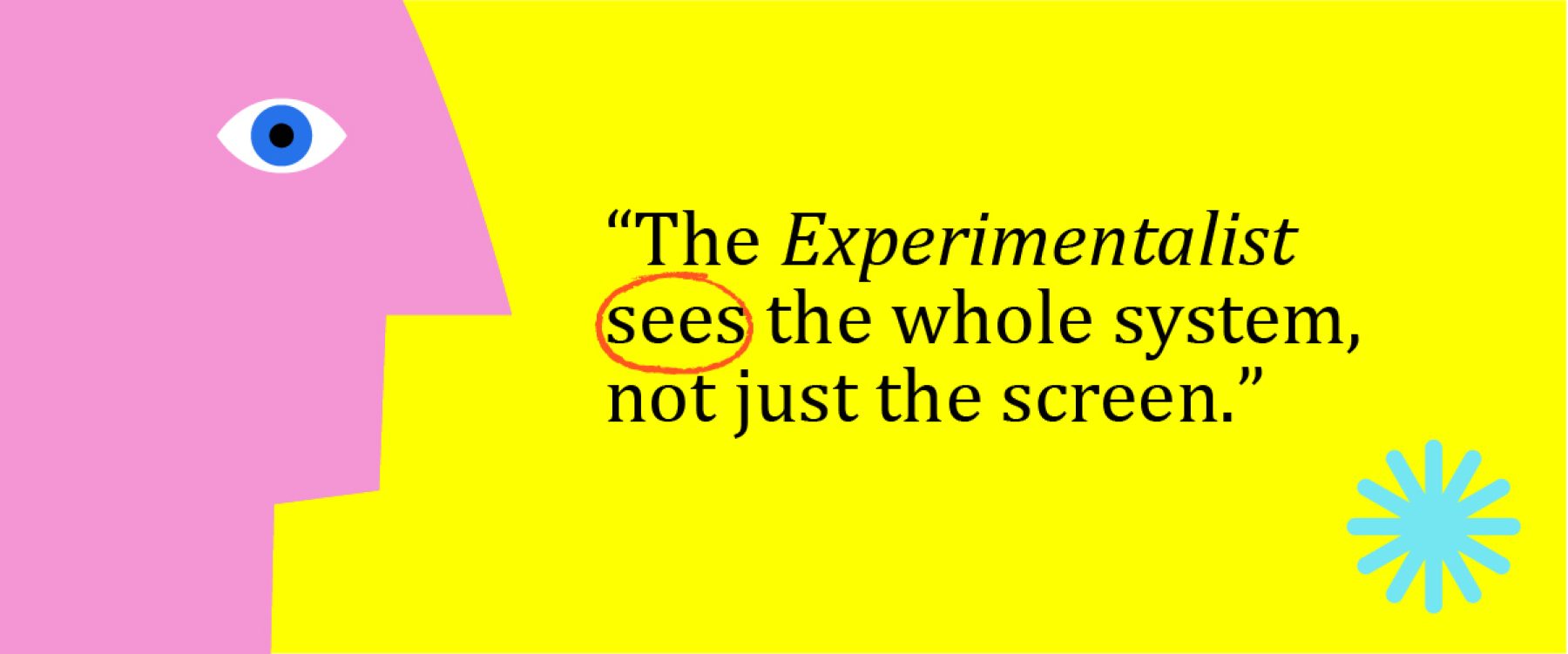
The Experimentalist is system-aware. Every design decision creates ripples across workflows, across patient experience, across the people who have to live with the thing after it we deliver it. Usability matters. So does what happens to the nurse three months in, the patient who can't read English at the eighth-grade level the form assumes, the clinician whose workflow you just rewired. The Experimentalist sees the whole system, not just the screen.
The Experimentalist is comfortable with not knowing. This is the one that surprises clients most. We don't begin with the answer. We begin with the right questions, and we earn our way to the answer through research, prototyping, and conversation. It's slower than guessing. It's also why the work holds up.
This is why human-centred design matters more in the age of AI, not less. Automation is excellent at producing outcomes faster. It is still poor at the deeper questions like why people behave the way they do, how trust gets built, what makes an experience feel like care rather than process. Those remain human contributions. We don't see that changing soon.
The shift, for us, has been clarifying. As the technical work gets easier, our value is no longer in production. It's in noticing. Connecting. Asking the question the brief didn't think to ask. Designing with humanity in mind, on purpose, every time.
So if you're thinking about how AI fits into the work ahead of you, here's our suggestion.
Stop vibe coding. Just find a vibe.
Find a point of view. Find a question worth answering. Find a problem that's actually worth your organization's time. The tools will be there. The harder, more valuable work — understanding people, systems, and consequences — is still ours to do.
That's the work we're here for. That's the work we've always been here for. It just has a better name now.